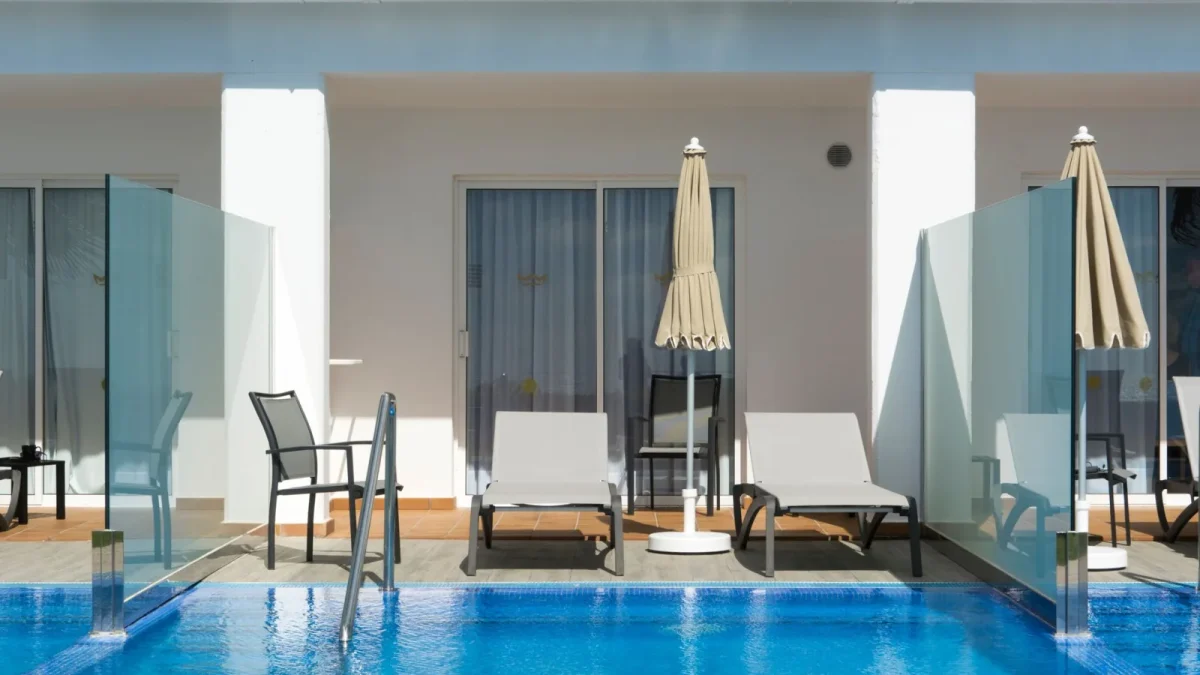
Key takeaways
- A full size robot needs several feet of open water to complete a turn, which most small pools and spas do not have.
- Wall thrash and a piled up cord are the two clearest signs a robot is oversized for its pool.
- Compact cordless models finish a small pool in well under their rated runtime, so turning radius matters more than battery capacity.
- Most robots need roughly 2.5-3 ft of water to submerge, prime, and turn, which rules many out for shallow spas.
- A right sized compact robot often costs less than a full size model, not more.
Your new robot drops into a 14 ft plunge pool and spends its first ninety seconds bouncing off all four walls before it manages a single clean lap. By the time the cycle ends, the cord has piled itself into a knot at the shallow end, and the water does not look meaningfully cleaner than when you started.
Nothing is broken. You bought a robot sized for a pool twice this size, and small water asks for a different kind of machine entirely.
Right sizing a robot for a small pool or spa comes down to four things: turning radius, cordless versus corded, cycle length, and the minimum depth a robot needs to work at all. Get those right and a $250 compact unit will outclean a $900 flagship in your water.
The overkill symptoms: wall thrash and cord pile
Wall thrash is easy to spot once you know the term. A full size robot enters a turn, runs out of room before the turn completes, and ends up bumping or spinning against the nearest wall two or three times before it straightens out. Watch from the deck for five minutes and you will see it happen on almost every lap.
Cord pile is the corded version of the same problem. A pool too small to let the robot roam ends up with slack cable coiling on itself near the entry point, and that coil is exactly what causes tangles and, eventually, a swivel that wears out early.
“I paid extra for the biggest name on the shelf, and it could not turn around in my own pool.”
There is a quieter symptom too. In a small footprint, a robot running a random coverage pattern loops back over the same few square feet again and again before it ever really spreads out, so cycles feel long relative to how little ground actually gets covered.
None of this is cheap to ignore. A flagship robot fighting a small pool still burns through brush wear and battery cycles at full speed, so you end up paying premium consumable prices for a machine that is effectively working against itself every run.
Turning radius: the spec nobody checks
Full size robots are engineered assuming several feet of clearance to complete a directional change smoothly. Give them that room and the turn looks effortless. Take it away and the machine either stalls, reverses awkwardly, or scrubs the same wall panel over and over.
A customer of mine bought a premium flagship for an 8 by 14 plunge pool on what I’d call bigger price tag, better clean logic. It was one of the most capable robots I had tested that year, and it was miserable in her water: constant wall contact, a cord that never settled, and a cycle that ran long without ever looking finished.
We swapped it for a $260 compact model built for tight spaces. Same pool, same debris load, a 40 minute cycle that actually finished, and a machine that turned inside its own length instead of fighting the walls to do it.
Turning radius rarely appears on a spec sheet in plain language, so the honest shortcut is pool length: under about 20 ft with a simple rectangular or oval shape, look specifically at the compact class rather than a manufacturer’s flagship line.
Mini models built for small water
Compact cordless units live in roughly the $200-350 band, and they are not simply smaller versions of a full size robot with less power. They are built around a tighter turning geometry, a lighter body, and a filter basket sized to match a smaller debris load, so nothing about them feels underpowered once the pool matches the machine.
The Aiper Scuba S1 is a widely sold example of this compact class, and the Wybot C1 shows up often in the same conversation for owners on a tighter budget. Neither is trying to be a flagship; both are trying to finish a small pool quickly and get out of the way.
Native cycle times in this class often run 30-60 minutes rather than the 90-180 minutes a full size pool demands, because there is simply less floor to cover. A short cycle here is not a corner cut, it is the correct amount of work.
Filtration in this class leans toward fine debris rather than leaf volume, and that fits spa use well. Sunscreen film, hair, and wind blown dust are the usual mess in a small plunge pool or spa, closer to standard 50 micron media territory than the coarse baskets a big oak lined pool needs.
Cordless advantage in tight water
Cordless models solve the cord pile problem by removing the cord entirely, which matters more in a small pool than a large one simply because there is less open water to absorb slack cable in the first place.
Battery capacity matters less here than owners assume. A pack rated for 90-180 minutes of runtime, built around the same kind of lithium-ion cells found in most cordless power tools, is designed for pools far bigger than a plunge pool or spa, so a compact robot typically finishes its job with plenty of charge to spare. Turning radius and weight do more for your experience than an extra hour of rated runtime ever will.
Lighter also means easier to live with. A compact cordless unit is simple to lift out with one hand after a cycle, which matters if you are pulling it from a spa several times a week rather than running a pool on a weekly cleaning schedule.
App pairing and mapping, genuinely useful on a large freeform pool, mostly go unused here. A pool this size does not have enough floor for a coverage map to tell you anything a five minute glance would not.
Spas and plunge pools: the depth floor
Size is not the only limit. Most robots need roughly 2.5-3 ft of water to fully submerge, prime themselves, and complete a turn without a bench seat or a shallow floor getting in the way.
Spillover spas and shallow soaking spas often sit under that line, and forcing a robot into water that shallow tends to end in weak suction, a machine that never quite primes, or one that beaches itself against a seat every lap.
Watch out
Check your minimum depth against the manual before buying for a spa. A robot that cannot fully submerge will not clean better with a longer cycle, it will just spend more time stuck.
Below that depth floor, five minutes with a hand brush and a net does more good than any robot, and costs nothing.
| Water size | Best fit | Typical cycle | Price band |
|---|---|---|---|
| Spa or plunge pool under 10 ft, 2.5 ft+ deep | Compact cordless | 20-40 minutes | $200-300 |
| Small pool, 10-20 ft, simple shape | Compact cordless or light corded | 30-60 minutes | $250-400 |
| Under 2.5 ft deep anywhere | Hand brush and net | 5-10 minutes manual | Under $30 |
- Measure your actual water, not the advertised pool size on the box it came in.
- Confirm minimum operating depth against the manual before buying for a spa.
- Favor the compact class under about 20 ft rather than a flagship model.
- Choose cordless first here; the runtime ceiling almost never matters at this size.
- Watch the first cycle for wall thrash and return it if turns still look like collisions.
Buying to the pool you actually have
A small pool or spa does not need less robot, it needs a differently shaped one: tighter turns, a shorter native cycle, and often a lower price tag than the flagship on the endcap.
Measure your water, check the depth floor, and buy from the compact class first. The $260 unit that turns cleanly in your own pool will always outperform the $900 machine that spends its cycle fighting your walls.
If you already own a robot that thrashes, do not assume it needs replacing outright. Try it in a friend’s larger pool first; a machine that suddenly behaves itself confirms the size mismatch rather than a defect, and that changes what you shop for next.
Frequently asked questions
Is a robot even worth it for a pool small enough to vacuum by hand in ten minutes?
Sometimes not. If the pool folds down each fall and a hand net or vacuum already takes ten minutes, a robot mostly buys convenience rather than a cleaner pool. The math shifts once the pool stays full all season, once fine dust or pollen becomes a weekly fight, or once your knees would rather not do the manual version anymore. A $220 compact unit earns its keep fast in either case.
Do mini robots clean as well as full size models, or are they a compromise?
For their intended footprint, they clean just as well, because filtration and brush contact do not scale down with the machine. What you give up is raw runtime and, on most models, wall climbing on steep or tall walls. In a small pool or spa neither loss matters much, since the floor is close and the walls are short.
Can I use a small pool robot in an inflatable or soft sided spa?
Usually yes, as long as the water is deep enough to submerge the robot and the floor cannot be punctured by tracks or wheels. Check the manual for both a minimum depth and any note about soft or vinyl floors, since a few models recommend gentler brush settings there. Drain plugs and folds in the liner are the usual snag points, so glance at the floor before the first run.
How do I know if my current robot is simply too big for my pool?
Watch one full cycle from the deck. Repeated bumping or spinning at the same walls, a cord that piles instead of laying out, and a cycle that runs long without the pool looking finished are the tells. If two or more of those show up every single run, the fix is usually a smaller, more agile machine rather than a repair.
Should a small pool robot run on the same schedule as a full size pool's robot?
Not necessarily. A small pool or spa collects less debris and finishes a cycle in a fraction of the time, so two shorter runs a week is often plenty compared to the three or four a larger pool wants. Watch the filter basket for a couple of weeks and let what comes out of it, not a generic schedule, set your actual frequency.

Krisha Gupta
Krisha Gupta is a home-technology writer who spends most of her weekends knee-deep in pools, testing the latest robotic cleaners so readers don't have to. Her reviews are hands-on and jargon-free, focused on what a robot actually does when you leave it running unsupervised for eight hours. When she's not comparing brush patterns or waterline scrubbing, she's writing plain-English maintenance guides for pool owners who'd rather swim than tinker.