
Key takeaways
- A robot that strands in the same place every run is hitting a physical obstacle, not failing mechanically.
- Raised dome drain covers are the top trap, and a low profile VGB compliant cover usually ends it.
- Ladder wedging stops the moment you lift the ladder out before runs or fit bumpers on the standoffs.
- Liner wrinkles snag light robots and wear the vinyl, so fix the wrinkle before it becomes a patch job.
- Change one variable per cycle, like drop point or mode, so you can prove which workaround worked.
Two Julys ago I spent a week testing a Dolphin Premier in a client’s kidney shaped gunite pool, and every morning I found it parked in the exact same place: nose up on the main drain, tracks spinning, going nowhere.
The owner was sure the motor was dying. It was not. The drain wore a raised anti vortex cover, about an inch of dome, and the robot treated it like a curb it could almost climb. Almost.
A pool robot stuck in the same spot every run is not bad luck. It is geometry, and once you name the obstacle, you can nearly always beat it.
Read the stranding like a service tech
Where the robot stops tells you why it stopped. Before changing anything, run a cycle and note the exact stuck point, the robot’s posture, and roughly when in the cycle it happened.
Three strandings in the same place is a pattern, and patterns have fixes. Random stops scattered around the pool usually mean a stuffed filter basket or a tired drive instead, which is a different repair entirely.
Ranked by how often I saw them on service calls, the repeat offenders are:
- Main drain covers, the number one catch point in inground pools
- Ladder legs and handrail bases
- Steps, benches, and tanning ledges
- Wrinkles and seams in a vinyl liner
- Toys, hoses, and cords that should not be in the water at all
Main drains: the number one robot trap
Flat, modern drain covers rarely stop anyone. The trouble is raised dome and anti vortex styles, which put a hard lip right where the robot’s intake and leading edge want to pass. The machine noses up, high centers, and spins its tracks until the cycle times out.
You get two workarounds and one real fix. Rotate your drop point so early passes approach the drain from a different angle, shorten the cycle so the robot spends less time in the deep end, or best of all, have the cover swapped for a low profile compliant model, typically a $20-60 part.
Safety first
Never pull a drain cover to keep the robot from catching on it. Uncovered or damaged drains are an entrapment hazard for swimmers, and covers are a regulated safety part with a stamped service life. The CPSC’s Pool Safely program covers why this one is not negotiable.
Ladders, rails, and the wedge zone
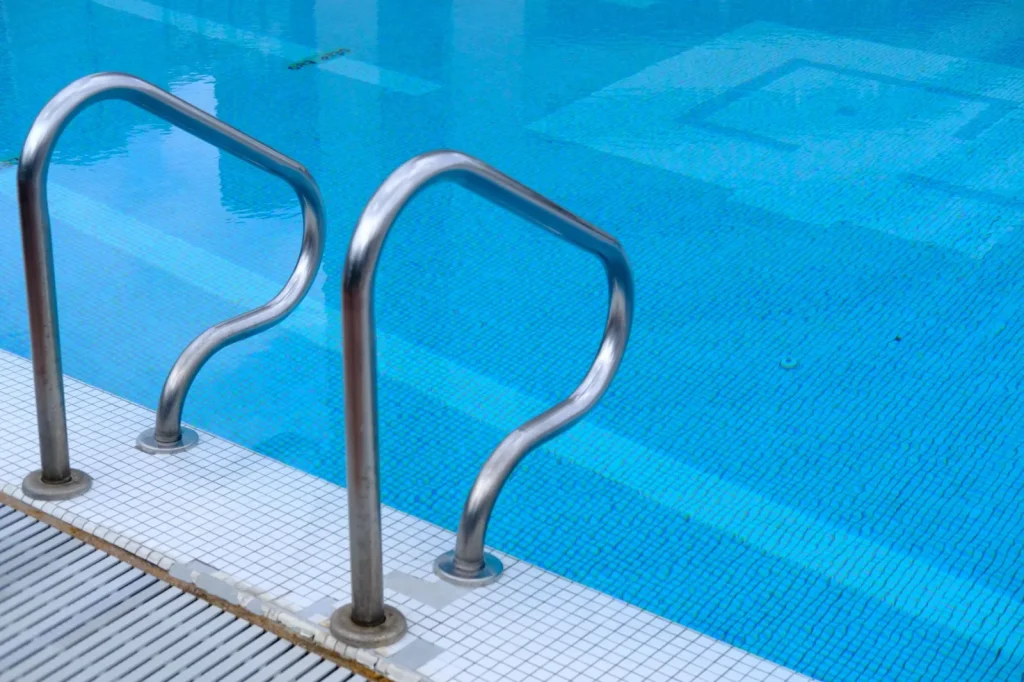
Ladder standoffs leave a gap between the legs and the wall that is exactly robot sized. The machine drives in during wall climbing passes, cannot complete a turn, and sits there pinned sideways until you rescue it.
In an above-ground pool it is worse, because A frame ladders add crossbraces at floor level that snag cords and catch track edges.
The 30 second habit that solves it: lift the ladder out before the robot runs. If the ladder is anchored, foam ladder bumpers or a guard kit closes the wedge gap for about $15-30. A mistake I saw weekly at the service counter was an owner returning a perfectly healthy robot over what turned out to be a $20 ladder problem.
Steps, benches, and tanning ledges
Shallow ledges strand robots in a sneakier way. The machine climbs on, the water gets too thin to feed the pump, and it beaches with its intake half out of the water. Running the pump dry like that is genuinely harmful, since the impeller and seals depend on water for cooling and lubrication.
Keep it off the ledge instead of hoping. Use floor-only mode on pools with big step zones, drop the robot at the far end so it works the deep half first, and give steps a two minute manual brush and spot clean when you skim. Premium mapping models such as the Beatbot AquaSense 2 let you draw no go zones in the app, which is the cleanest fix if your robot supports it.
Vinyl liner wrinkles and seams
A wrinkle no taller than a pencil can stop a lightweight robot cold. The leading edge plows into the fold, the tracks lose grip on the loose vinyl, and the machine parks on the same crease every single cycle.
Wrinkles are also the one obstacle that fights back. Every snag rubs the same worn line in the liner, and a liner job runs well into four figures, so the wrinkle itself is the thing to fix. Small ones can sometimes be worked flat while the pool is warm; big or spreading ones deserve a liner pro.
Until it is fixed, approach matters. Change the drop point so the robot crosses the wrinkle parallel to the fold instead of head on, and heavier tracked machines cross folds better than light wheeled ones.

Know what your robot can and cannot see
Budget machines like the Wybot C1 steer by bump logic and internal gyros, dead reckoning their way around the pool. A gyro measures turns, not obstacles, which is why the robot happily drives into the same drain dome forever; the concept is worth two minutes on how a gyroscope works if you are curious.
Even camera and ultrasonic mapping models mostly see walls and open floor, not a one inch lip. The obstacle map that matters is the one you build yourself: walk the pool on a clear day and inventory everything taller than an inch, including drain domes, ladder feet, return fittings, and folds.
Match the trap to the fix
| Stuck zone | Telltale posture | Fast workaround | Permanent fix |
|---|---|---|---|
| Main drain | Nose up, high centered, tracks spinning | Rotate drop point, shorter cycle | Low profile compliant cover |
| Ladder base | Wedged sideways between legs and wall | Lift ladder out before runs | Bumpers or guard kit |
| Steps and ledges | Beached with intake near the surface | Floor-only mode, far end drop | App no go zones, manual step care |
| Liner wrinkle | Parked against a visible fold | Cross the fold parallel, not head on | Have the wrinkle worked flat |
| Toys and hoses | Wrapped or pinned mid floor | Net and clear before every run | Poolside storage basket habit |
The 15 minute stuck audit
- Sketch the pool outline on paper, run one full cycle, and mark every stall point.
- Note posture at each stall: high centered, wedged, beached, or wrapped.
- Inventory the floor for anything with an edge taller than an inch.
- Change exactly one variable per run so you know which change worked.
- Recheck after liner work, new toys, or any new fitting in the pool.
Do the audit once and you will know your pool’s traps better than any app map does. Most owners find exactly one culprit, occasionally two.
Getting unstuck for good
Nearly every same spot stranding comes down to one obstacle plus one habit, and both are cheap to change. A $40 drain cover, a lifted ladder, or a smoothed wrinkle beats a $900 robot swap every time.
Fix the trap, rotate your drop points for a week, and watch the coverage pattern open back up. The first clean where the robot crosses its old graveyard without a pause is a small, genuinely satisfying win, and your far corner stops collecting the debris the stalled cycles kept missing.
Frequently asked questions
Will getting stuck burn out the robot's motor?
Usually not right away. Most robots carry stall protection that cuts drive power when the tracks cannot move, and thermal cutouts as a backup. The slow damage is real though: spinning tracks glaze and stretch, and repeated stalls add hours of wear without any cleaning to show for it. Treat a weekly stranding as a maintenance problem, not a quirk.
Do app no go zones actually keep robots out of trouble?
On true mapping models they work well for broad areas like step zones and tanning ledges, though the map can drift a few inches between cycles, so leave a margin around the obstacle. They cannot protect against things the map does not model, like a raised drain lip. Budget bump and gyro machines do not offer them at all.
Should I take the ladder out every single time the robot runs?
If your robot wedges at the ladder even occasionally, yes, and it takes about 30 seconds. Owners who leave anchored ladders in place should fit foam bumpers or a guard kit in the $15-30 range instead. Either approach ends the wedge stalls, and removing the ladder also protects its finish from brush contact during wall passes.
Can I run my pool robot while a suction or pressure cleaner is in the water?
No, and this causes some of the strangest stuck calls I ever took. The robot drives over the other cleaner's hose, wraps it, and both machines stall. Pull the hose cleaner and its lines out before robot cycles. The two systems also fight over the same debris, so running both at once buys you nothing.
Why does my robot stall everywhere during the first cold week of the season?
Water under roughly 55-60F stiffens tracks and thickens the grease in drive trains, so a robot that sailed over a drain lip in August plows into it in April. Weak early season traction also makes wrinkles and slopes harder to cross. Wait for water above 60F before judging performance, and treat spring stalls as a temperature note, not a defect.

Krisha Gupta
Krisha Gupta is a home-technology writer who spends most of her weekends knee-deep in pools, testing the latest robotic cleaners so readers don't have to. Her reviews are hands-on and jargon-free, focused on what a robot actually does when you leave it running unsupervised for eight hours. When she's not comparing brush patterns or waterline scrubbing, she's writing plain-English maintenance guides for pool owners who'd rather swim than tinker.


